

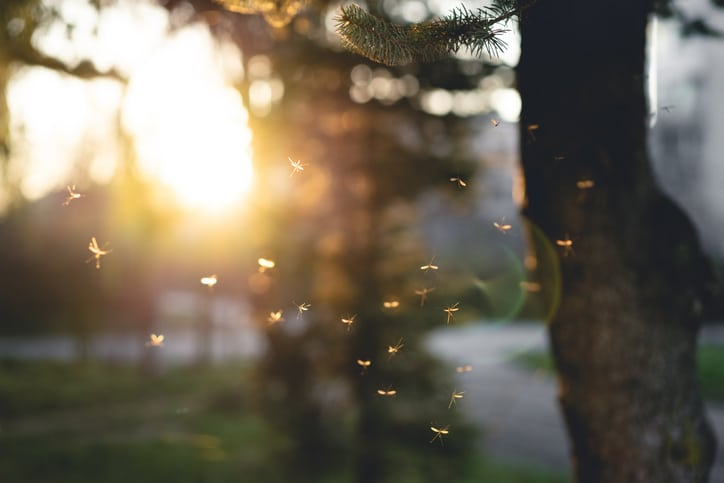
When August rolls around, it’s time to savor those last sweet weeks of summer. But the heat and sunshine also bring out a surge in dangerous summer pests. Many bite, others sting, and some just won’t leave you alone.
Do you know what’s buzzing around your yard? From aggressive yellow jackets to disease-carrying mosquitoes, here’s how to spot the most common flying pests in Massachusetts this month.
How To Identify 5 Common Flying Pests
When identifying common flying pests, focus on their size, shape, color, behavior, and nesting habits.
Summer Stingers You’ll Want To Avoid
Yellow Jackets
- Appearance: Bright yellow and black stripes, compact bodies.
- Behavior: Highly aggressive in late summer. Often nest underground, in wall voids, or in shrubs.
- Risk Level: High — painful stings and allergic reactions.
- Pro Tip: If you see them swarming near a structure or bush, keep your distance and call a professional.
Want to dig deeper into yellow jackets? This post will help you better spot yellow jacket nests.
Hornets
- Appearance: Larger than yellow jackets; bald-faced hornets are black with white markings.
- Behavior: Build large paper nests high in trees or on buildings. Defend their nests aggressively.
- Risk Level: High — multiple stings possible.
- Pro Tip: Avoid disturbing their nests.
Paper Wasps
- Appearance: Slender bodies, long legs, brownish with yellow or reddish markings.
- Behavior: Build umbrella-shaped paper nests under eaves, decks, or in branches.
- Risk Level: Moderate — sting if threatened.
- Pro Tip: Watch for small nests early in the season before they expand.
Summer Biters & Nuisance Flyers
Mosquitoes
- Appearance: Small, delicate, long-legged, with a distinctive high-pitched buzz.
- Behavior: Most likely to bite at dawn and dusk. Breed in places like birdbaths, gutters, and puddles.
- Risk Level: High — disease risk.
- Pro Tip: Remove standing water to reduce breeding sites.
Cluster Flies
- Appearance: Larger and slower than houseflies, dark gray with golden hairs on their thorax.
- Behavior: Gather in large groups, sunning themselves on sunny walls or windows in late summer.
- Risk Level: Low — nuisance only.
- Pro Tip: Seal up cracks around windows to prevent a bigger fall infestation inside your home.
Wondering if it’s a housefly or a cluster fly? Here’s a helpful fly identification chart for homeowners.
DIY vs. Calling a Pro: When To Handle It Yourself
DIY may work if:
- You have only a few nuisance flies or mosquitoes.
- You spot a small wasp nest early in the spring (and can reach it safely).
- You want to use repellents or traps for short-term relief.
Call a professional if:
- Pests are aggressive or swarming near high-traffic areas.
- The nest is large, hard to reach, or inside a wall.
- You’re still dealing with problems despite DIY efforts.
- You or your family members are allergic to stings.
Don’t Let Flying Bugs Take Over
Flying pests can ruin your summer fun and even pose health risks. If you’ve noticed an increase in swarming around your home, Ford's Hometown Services can help you tell those pests to buzz off before the season ends. Get a quote online or give us a call at (774) 418-4908, and let’s reclaim your yard.