

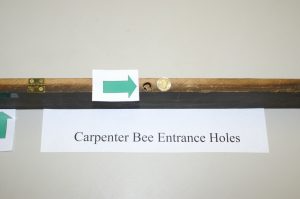
Carpenter bees are very often seen hovering around the late-spring and early summer looking for nesting sites. These solitary bees look similar to bumble bees but their nesting habits are quite different. Bumblebees are usually ground nesting while carpenter bees tunnel into wood to lay their eggs. They prefer to nest in bare, unpainted and weathered softwoods such as fir, redwood, cedar, cypress and pine. The male bee will aggressively hover but is stingless and the female has a stinger but will only resort to stinging if handled.
In the spring, mating occurs and the female searches for a site to excavate. The entrance hole is slightly smaller than ½ inch and is perfectly round. Once a female has excavated her entrance hole, she will make a 90-degree angle often to both the right and left side. She will chew tunnels often exceeding a foot in length, thus creating extensive damage that is non-visible from the outside of the structure. During excavation, coarse sawdust mixes with the bee’s excrement and pollen which causes staining to siding and any other object it comes in contact with. After the female creates 6-10 brood cells in a row and fills each with a pollen and nectar “food ball” then walls off the hole with a plug of chewed wood pulp. Are you being bugged, call today!
For treatment pricing and procedure please call: (774) 418-4908.